
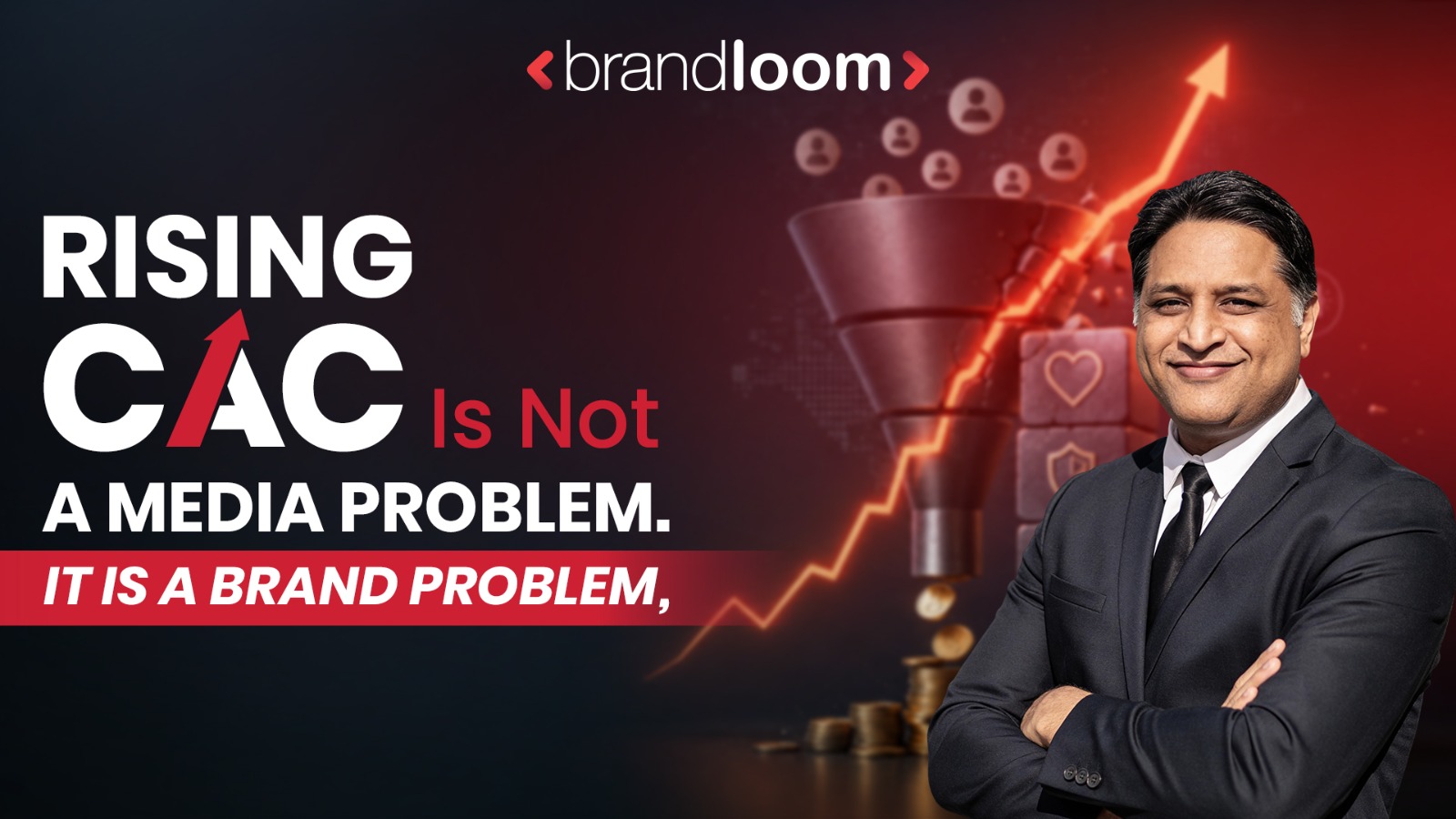
New Delhi, India — June 30, 2026 The CAC crisis gripping digital marketers today is being fundamentally misdiagnosed, argues BrandLoom, a growth-focused branding and digital consulting firm. Brands with weak, undifferentiated positioning will see their CAC continue to rise, and their margins shrink, says BrandLoom.
A study shows that 84% of companies are stuck in a brand “doom loop,” a cycle in which underfunded measurement leads to unclear impact, rising skepticism, and tighter budgets.
“Businesses keep looking for the answer in their channel mix or their bid strategy,” said Avinash Chandra, Founder and CEO of BrandLoom. “But when positioning is unclear, you end up talking to everyone and converting no one. The media spend becomes a tax on the absence of differentiation.”
The CAC Inflation Is a Brand Problem, Not A Media Problem
Google and Meta CPCs have been rising sharply year on year. Average conversion rates across industries sit at just two to three percent. B2B purchase decisions now involve six to ten decision-makers, stretching sales cycles and compounding acquisition costs at every stage.
But BrandLoom points to a less visible force driving CAC inflation that media optimization cannot fix. When brands carry generic messaging, compete on price by default, and chase channel performance before establishing what they stand for, they create a structural inefficiency that compounds over time.
Every rupee spent on reach amplifies a message that does not differentiate. Every conversion arrives harder and costs more than it should.
“The real CAC culprits are strategic, not tactical,” Chandra said. “Talking to everyone, competing on price, chasing channels before clarifying the message, these are positioning failures. And you cannot solve a positioning failure by optimizing your CPM.”
Strong Positioning Helps Reduce CAC and Improve Revenue Over Time
The financial case for brand positioning is more concrete than most marketing conversations acknowledge.
Strongly positioned brands command price premiums over undifferentiated competitors. Companies with clearly defined positioning grow faster.
Referrals, the most direct output of brand trust, carry a significantly higher lifetime value than leads from other channels.
These are acquisition economics, not vanity metrics.
“Brand authority is a CAC multiplier,” Chandra said. “It does not just make your marketing feel better. It makes your entire acquisition engine structurally more efficient. The best-positioned brands are also, almost without exception, the most capital-efficient acquirers of customers.”
The Positioning Failures Driving CAC Up
BrandLoom has identified a consistent set of positioning failures it sees across growth-stage and enterprise organizations. Broad audience profiles with no defined Ideal Customer Profile. Messaging built around features and capabilities rather than measurable outcomes.
Inconsistent communication across platforms erodes brand recognition rather than building it. Bold claims with no proof points attached. And perhaps most damaging, a heavy investment in reach before establishing what the brand actually stands for.
“If you removed your logo from your website, your social media, and your sales deck, would anyone know it was you?” Chandra said. “If the answer is no, you do not have a media problem. You have a positioning problem. And that is what is driving your CAC.”
BrandLoom’s Five-Step Positioning Framework: From Brand Clarity to CAC Reduction
BrandLoom’s approach to reducing CAC through positioning is built on a five-step framework: Research, Define, Articulate, Align, and Measure, beginning with a rigorous audit of customer interviews, win-loss analysis, the competitive landscape, and internal surveys to establish the strategic foundation.
Critically, BrandLoom treats positioning not as a marketing deliverable but as a company-wide strategic anchor. When positioning is clear, it aligns sales, product, marketing, and leadership around a single coherent narrative, creating a fundamentally more efficient growth system, not just better advertising.
Within BrandLoom’s AIM Growth Architecture, positioning clarity is the prerequisite for strategic alignment. Without it, integration amplifies noise. With it, every initiative, paid, organic, and content referral compounds toward the same outcome.
“Positioning is not a tagline or a logo refresh. It is the strategic declaration of the unique space your brand owns in the customer’s mind,” Chandra said. “When that space is clearly held, the entire economics of growth changes.”
About BrandLoom
BrandLoom is a Strategic Brand, Digital, Design & Intelligence Partner helping businesses build scalable, measurable, and trust-driven growth systems.
We help growth-focused and enterprise brands move beyond fragmented marketing activities by integrating brand strategy, digital growth, customer experience, analytics, and AI-enhanced intelligence into connected growth systems designed to improve visibility, customer acquisition, customer experience, operational efficiency, and measurable ROI.
Through its integrated growth approach, BrandLoom combines strategy, creativity, digital performance, design, analytics, and AI-powered intelligence to help businesses scale more effectively in the evolving digital economy.
Learn more at: www.brandloom.com
