
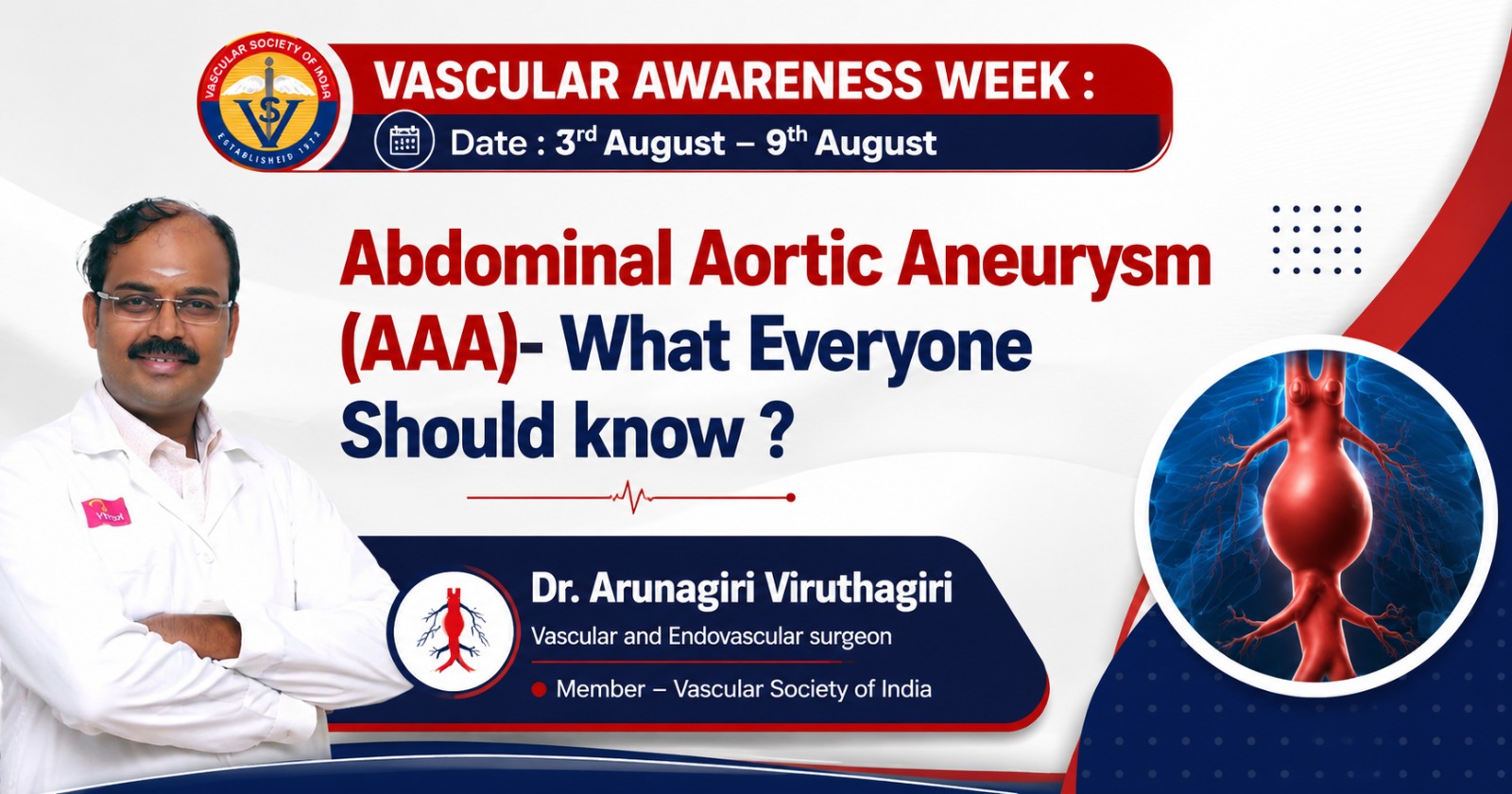
1. What is an abdominal aortic aneurysm?
The aorta is the largest artery in the body, carrying oxygen-rich blood from the heart to all organs. Abdominal aortic aneurysm (AAA) is an abnormal enlargement of the abdominal aorta and defined as an aortic diameter of 3 cm or more.
2. How common is abdominal aortic aneurysm?
AAA affects approximately 1–3% of adults over 65 years in most patients. It is 4–6 times more common in men than women. The risk increases with age >65 years, Smoking, High blood pressure, Family history, Atherosclerosis, High cholesterol, Male sex
3. How are aneurysms diagnosed ?
Most aneurysms are discovered incidentally during ultrasound or CT scans performed for other reasons.
4. Is an abdominal aortic aneurysm dangerous?
Yes. Small aneurysms are usually monitored, but as they enlarge the wall weakens and may rupture. A ruptured aneurysm has a mortality exceeding 70–80%, making early detection extremely important.
5. What are the symptoms?
Most patients have no symptoms. When symptoms occur, they may include deep abdominal pain, back pain, flank pain, pulsating abdominal swelling
6. What are the symptoms are ruptured aneurysm ?
A ruptured aneurysm causes sudden severe abdominal or back pain, fainting, Low blood pressure
Cold skin. And it’s a surgical emergency.
6. Who should undergo screening?
A simple ultrasound screening in men aged ≥65 years, particularly those who have ever smoked.
First-degree relatives of patients with AAA may also benefit from screening, especially from age 50 years onward.
7. Which imaging tests diagnose AAA?
– Ultrasound is preferred as a first-line investigation because it has no radiation, it’s quick and ideal for screening and surveillance
– CT Angiography (CTA) is the gold standard before surgery. It clearly depicts and shows aneurysm anatomy which is essential for planning EVAR or open repair
8. How often should aneurysms be monitored?
Routine surveillance depends on the size of aneurysm size. It is recommended timeline are
3.0–3.9 cm: every 3 years
4.0–4.9 cm: yearly
≥5.0 cm: every 3–6 months until repair is considered
9. When is surgery required?
Elective repair is generally recommended when:
– Diameter ≥5.5 cm in men
– Rapid expansion (>1 cm/year or clinically significant rapid growth)
– Symptomatic aneurysm (pain or tenderness)
– Ruptured aneurysm (emergency)
– Women may be considered for repair at smaller diameters (around 5.0 cm) because rupture risk is higher at smaller sizes.
8. What are the treatment options available now ?
Medical management is suitable for smaller aneurysms and can be managed with conservative approach. It includes smoking cessation, blood pressure control, cholesterol control, regular physical activity and diabetes control
9. What are the various surgical options available ?
Endovascular Aneurysm Repair (EVAR) is a minimally invasive intervention which is performed through groin arteries. It is preferred in high risk group, frail patients. It offers faster recovery and has less postoperative pain. Major drawback is it requires lifelong imaging and surveillance in selected group of patients
10. What are the open surgical techniques ?
Open surgical repair is the gold standard for suitable patients who are young and who have good performance status. It offers excellent long-term durability and preferred when anatomy is unsuitable for EVAR. However, the treatment choices are individualized through shared decision-making.
To summarize and key take home message for the public,
- Most abdominal aortic aneurysms cme ause no symptoms.
- Ultrasound is a simple, painless screening test.
- Smoking is the biggest preventable risk factor.
- Small aneurysms are monitored safely.
- Large aneurysms can be treated before rupture.
- Sudden severe abdominal or back pain in a person with an aneurysm is a surgical emergency
Dr. Arunagiri Viruthagiri MS.,DNB., MCh
Senior Consultant & Head
Department of Vascular & Endovascular Surgery
Kauvery Hospitals, Tennur
Trichy
